
Game development
Based on the makers’ specs and my own testing where I say so.
Unity vs Unreal Engine
Unity or Unreal? Here's which one fits your first game, your PC and your budget.
Updated 10 min readYuval Eizik
- unity
- unreal
- tingbase
- engines
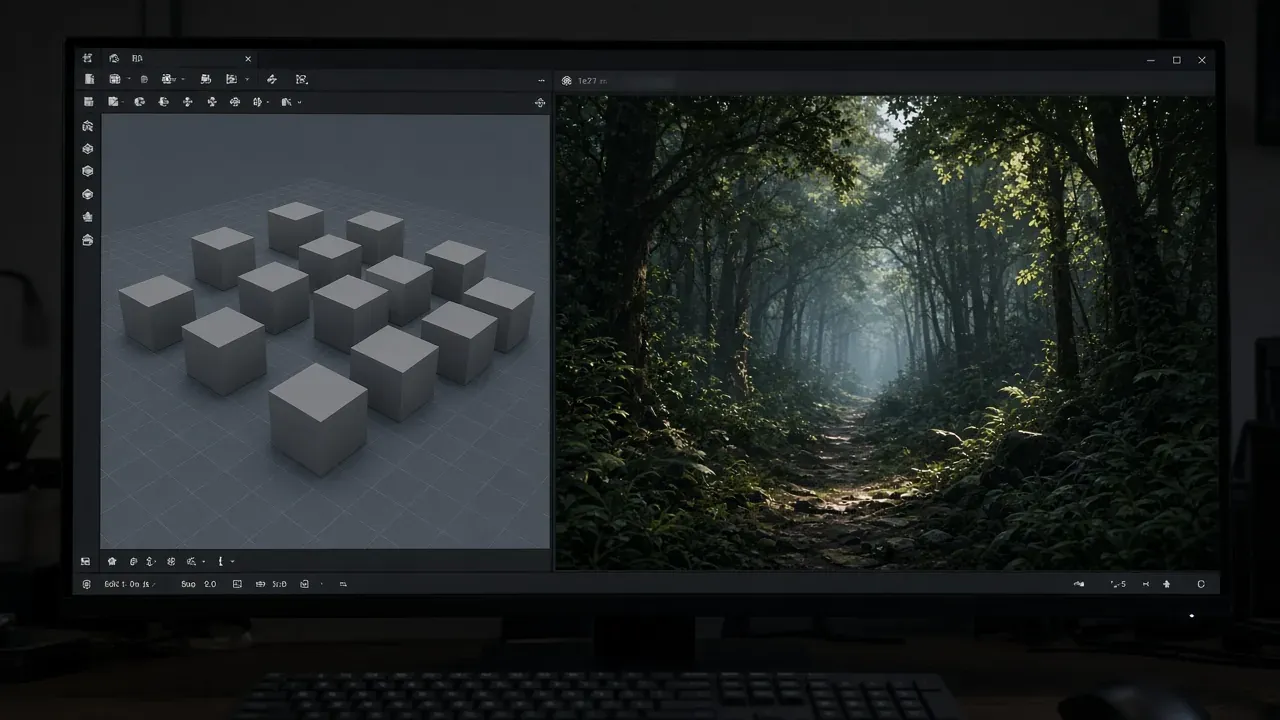
On this page
I write C# in Unity 6 every week. I am building Tingbase in Unity, and Studio Stigma used Unity for the P2M VR simulation. I haven’t shipped a commercial Unreal title, so the Unreal side leans on Epic’s current docs and licence.
The useful question is not “which engine is better.” It is which one fits the game, the team, and the hardware you already own.
Quick verdict
Pick Unity if the game is 2D, mobile, web, stylized 3D, standalone VR, or a small team that wants one language (C#) and a lighter editor. I stay here for Tingbase and for client work that has to iterate in days, not months.
Pick Unreal if the selling point is high-fidelity 3D on current PC or console hardware, you want Lumen and Nanite in the box, or the team already writes C++ and wants engine source on GitHub.
Both are free to start. Unity Personal is free under $200,000 USD of trailing-twelve-month revenue and funding. Unreal is free to download; a shipped game pays 5% royalty after $1 million USD lifetime gross per product, with Epic Games Store sales excluded from that base.
Do not pick from a render trailer. Pick from the first loop you can finish. If that loop is a sprite and a jump, Unity will get you to Play faster. If that loop is a photoreal room with bouncing light, Unreal is built for that room.
Versions as of October 2026
Engine versions and licence terms change, so check the official pages before you commit. Licences change. Read the live terms before you sign a deal.
- Unity 6 family. Unity 6.3 LTS is the current long-term support line (two-year support through December 2027; a third year for Enterprise and Industry). Unity 6.0 LTS is supported through October 2026. Unity also ships Supported Update releases between LTS drops.
- Unreal Engine 5.x. Epic’s current public documentation is Unreal Engine 5.8. A 5.8.4 hotfix is out. Install from the Epic Games Launcher or from source.
Comparison table
| Topic | Unity 6 | Unreal Engine 5 |
|---|---|---|
| Cost to start | Free on Personal under $200K TTM revenue/funding | Free to download and use for games |
| Paid seat | Pro $2,310/yr or $210/mo per seat (Jan 2026 price). Enterprise required above $25M | Non-game commercial use above $1M company revenue: $1,850 per seat per year |
| Royalty / runtime fee | Runtime Fee cancelled (12 Sep 2024). Seat model only | 5% of worldwide gross after $1M lifetime per product; 3.5% if it stays a Launch Everywhere with Epic Release; EGS sales excluded |
| Splash screen | Optional on Unity 6 Personal (pricing updates) | No Unity-style mandatory splash |
| Language | C#. Optional Visual Scripting package | C++ and Blueprints |
| Graphics | URP for wide hardware, HDRP for high-end | Lumen, Nanite, virtual shadow maps, World Partition |
| Learning curve | Faster for C# and component scenes | Steeper editor; Blueprints soften the first week |
| 2D | Built-in Tilemap, 2D lights, Sprite Shape, 2D physics | Paper2D plus community plugins |
| Mobile | First-class Android/iOS player targets in the system requirements | Supported; heavier default footprint |
| Web | Documented Web player (WebGL 2 / Wasm, including mobile browsers in current docs) | No official web export in the 5.8 platform docs |
| VR / XR | Quest, OpenXR, ARCore, visionOS in the same requirements page | Strong high-end XR and virtual production |
| Multiplayer | Unity 6 end-to-end multiplayer stack (official Unity 6 page) | Built-in replication and dedicated-server workflow |
| Consoles | Switch, Switch 2, PS4/PS5, Xbox One/Series. Pro or a Preferred Platform key, plus platform-holder approval | Included in the standard licence; still needs platform-holder approval |
| Marketplace | Unity Asset Store | Fab (in-editor window in UE 5.8) |
| Source | Read-only source on Enterprise | Full engine source on GitHub for licensees |
| Jobs | C# transfers to other.NET work | C++ plus Unreal is common on high-fidelity 3D teams |
Cost, royalties, and the Runtime Fee
Unity’s 2023 Runtime Fee announcement is why a lot of comparison pages still sound angry. The current fact is simpler: Unity cancelled it on 12 September 2024, said it never applied to any shipped game, and went back to seats.
As of the 2026 pricing page:
- Personal: free if Total Finances stay at or under $200,000 USD in the most recent 12 months. The Editor Software Terms spell out how client work counts.
- Pro: $2,310 per seat per year prepaid, or $210 per seat per month. Required once you are over $200K. Console and Apple Vision Pro publishing sit here.
- Enterprise: custom, required at $25 million USD trailing-twelve-month revenue and funding.
- Industry: separate track for non-games sectors above $1 million.
Unreal’s game licence is a royalty, not a seat, until you are a non-game company over $1 million:
- Free to use while you build.
- After a product’s lifetime gross passes $1 million USD, pay 5% of worldwide gross. Epic’s EULA examples use the store price, not the amount the store remits after its cut.
- Epic Games Store revenue is excluded from the royalty base (licence page).
- Launch Everywhere with Epic Release (on or after 1 January 2025, with store parity rules) drops the rate to 3.5% while the product still qualifies.
- A quarter under $10,000 is excluded.
- You notify Epic with the Release Form when you start collecting revenue (release guidelines).
For a first indie game, both engines usually cost $0 until you are doing well enough that the licence is a good problem. I still read the live terms before I quote a number to a client.
Language and day-to-day work
Unity gameplay is C#. I open the project in Cursor, change one script, click back into the editor, and press Play. Scenes and prefabs stay in Unity; I do not let an assistant rewrite .unity YAML. That loop is why I stay on Unity for Tingbase.
Unreal gameplay is C++ and Blueprints. Blueprints are native visual scripting and they are how a lot of Unreal teams prototype without touching the compiler. Unity’s Visual Scripting package exists and is released for Unity 6.0. I do not use it on Tingbase. I would rather keep one language.
C++ isn’t “just harder C#.” It is a different memory model, a different build, and a different hiring pool. If your team already writes C++, Unreal does not punish that. If your team is two people who know C#, Unity does not ask them to become compiler engineers to ship a 2D game.
Graphics
Unreal 5’s public pitch is photoreal 3D on current hardware: Lumen, Nanite, and World Partition. That is a real advantage when the screenshot is the product.
Unity 6 splits the problem. URP is the pipeline I reach for when the game has to run on a laptop and a phone. HDRP is the high-end path. Unity’s own Unity 6 page claims up to 4x CPU performance versus an earlier baseline in internal tests. Treat that as Unity’s own number.
Stylized 3D, UI-heavy games, and anything that must stay readable at 60+ on mid hardware are not Unreal-only jobs. They are often easier in Unity because you are not fighting a default that assumes a dedicated GPU.
Learning curve
Unity’s scene and prefab model is small. Hierarchy, Inspector, Play. A first game can be one scene and one verb.
Unreal’s editor shows more of the engine on day one. That is useful later and noisy at the start. Blueprints help. Documentation is large; some of it still assumes you already know the names of the systems.
I would not teach a first-time programmer Unreal C++ as their first language. I would teach them a scoped first game in the engine that matches the art.
2D, mobile, and web
This is the cluster where Unity still wins for me.
- 2D. Tilemaps, 2D lights, and sprite tooling are built in. Unreal can do 2D through Paper2D. I would not start a pixel-art game in Unreal unless the team already lived there.
- Mobile. Unity’s player requirements list Android 8+ and iOS 15+ on current 6.x docs, with URP aimed at those GPUs. Unreal can ship on phones. The empty-project weight and the lighting defaults are the usual complaints.
- Web. Unity documents a Web platform (WebGL 2.0, Wasm, desktop and mobile browsers). If the game has to live in a tab, I start in Unity.
VR
Studio Stigma built the P2M piece as an interactive VR counter, not a slide deck. Customers walk in with a laptop, a camera, or a bracelet; you drag a price under a timer. Unity isn’t the only VR engine, but it’s the stack I already trust for Quest-class hardware and for a client who needs a clear loop, not a cinematic.
Unreal is the usual pick when the room itself has to look like a film set. Virtual production lives there. If your brief is LED stages and MetaHumans, start with Epic’s current XR docs, not with my pawn-shop demo.
Multiplayer
Unity 6’s marketing page puts an end-to-end multiplayer workflow in the box. Unreal has shipped replication and dedicated servers for a long time. The netcode you pair with the engine (official packages, Photon, a custom server) often matters more than the logo on the splash.
Tingbase is a 3v3 hero shooter. I am not going to pretend I solved Unreal replication. I will say this: pick the stack you can debug. A lobby you do not understand will eat the year you meant to spend on feel.
Asset stores, community, jobs
Unity’s Asset Store is still the place I search first for a C# widget. Unreal’s storefront is now Fab, with an in-editor window in 5.8. Fab also lists Unity-format content. Do not buy an asset until you have read the licence and the engine version.
What I can say from hiring and from writing C#: Unity C# is readable to anyone who has done.NET. Unreal C++ plus Blueprints is a more specific CV line and a common requirement on high-fidelity 3D teams. Learn the engine your target studio actually opens.
Which should you choose
| Your project | Start here | Why |
|---|---|---|
| 2D platformer, card game, pixel RPG | Unity | Built-in 2D tools |
| Mobile or web first | Unity | Documented mobile and Web players, lighter defaults |
| Stylized 3D indie on PC | Unity, unless the team is already Unreal | Faster iteration in C# |
| Photoreal third-person or first-person on PC/console | Unreal | Lumen, Nanite, World Partition |
| Large open world | Unreal, usually | World Partition is built in |
| Standalone VR demo or training sim | Unity for my work; Unreal if the brief is film lighting | I shipped P2M in Unity |
| Virtual production / LED stage | Unreal | That is Epic’s non-game strength |
| Team is C# only | Unity | One language |
| Team is C++ and wants engine source | Unreal | Source on GitHub |
| First game, two months, one person | Unity | Finish a small loop |
If you are still stuck, write the sentence of the game, then look at the art. Photoreal room: Unreal. Readable verbs on a phone: Unity. Then cut until the engine choice is the least interesting decision on the list. Beginners who want the wider field (Godot, GameMaker) can start with best game engines for beginners. If Unity is the pick, how to make a game in Unity is the Hub-to-Play path. A Steam page comes after the loop: indie game marketing on Steam.
How I choose, in practice
Tingbase stays in Unity 6 because the work is C#, competitive timing, and a Steam page I can iterate on. If you want to see the game, the wishlist is on Steam. The engine choice was not a brand decision. It was the language I already write and the editor I can keep on a dual-monitor desk next to Cursor.
P2M was the same rule applied to a client: a VR loop that had to be obvious in three minutes. Unity’s XR path and a C# codebase I could change the same afternoon were the constraints.
I would open Unreal for a project whose pitch is the lighting. I would not open it to prove I can. That is how first games die.
Sensitivity and input tools I use while I playtest live at /tools. Studio notes and other shipped work sit under /projects.
Related: Game development, How I build this website, Mini Games Arena.
Common questions
Is Unity or Unreal better for beginners?
Unity is usually the shorter path if you already think in C# or you want a 2D, mobile, or web game. Unreal is learnable, especially with Blueprints, but the editor and C++ path are heavier. The better first engine is the one that matches the first game you will actually finish.
Is Unity still free after the Runtime Fee news?
Yes. Unity cancelled the Runtime Fee on 12 September 2024 and says it was never applied to any game. Unity Personal stays free under the $200,000 USD trailing-twelve-month revenue and funding threshold. Recheck Unity's pricing page before you cross that line.
Does Unreal charge a royalty on every game?
No. Under Epic's standard EULA, a game that ships Unreal runtime code pays 5% of worldwide gross revenue after the first $1 million USD lifetime per product. Epic Games Store revenue is excluded from that royalty base. A product that qualifies as a Launch Everywhere with Epic Release pays 3.5% going forward. There is also a quarterly exclusion when a product earns under $10,000 in a calendar quarter.
Can Unreal make 2D games?
Yes. Paper2D still exists in current Unreal docs. Unity's 2D tools (Tilemap, 2D lights, Sprite Shape, 2D physics) are first-class and are what I would start with for a sprite game.
Which engine is better for VR?
I shipped a VR pawn-shop simulation for P2M through Studio Stigma, and that work sat in the Unity XR stack. Unity documents Meta Quest devices, OpenXR, ARCore, and visionOS. Unreal is used heavily in virtual production and high-end XR. Pick from the headset, the visual target, and the language your team already writes.
Do I need Unity Pro to ship on Steam?
No. Steam is a PC storefront. Unity's docs require Pro, or a platform-holder Preferred Platform key, for closed consoles (Nintendo, PlayStation, Xbox). Personal can ship a PC or mobile game if you stay under the finance threshold.
Should I switch engines mid-project?
Almost never. Porting a live game is a new project. Finish the current loop in the engine you started, then decide on the next title.
Keep reading
Game development
Best game engines for beginners
Unity, Godot, Unreal or GameMaker? Which engine to pick for your first game, from someone shipping in Unity 6.
October 20, 2026 · 7 min read
Game development
Best AI tools for game development
A ranked, category-by-category list of AI tools I actually use or would pay for in a Unity 6 project: Cursor, Copilot, art, 3D, audio, animation.
October 20, 2026 · 8 min read
Game development
How to make a game in Unity
A Unity 6 beginner path from Hub install to a playable loop. Written from Unity 6 C# work on Tingbase, not from a copied 2022 tutorial.
October 20, 2026 · 7 min read
Game development
Indie game marketing on Steam
How Steam wishlists, Coming Soon pages, demos and Next Fest actually work, from a dev with a live Coming Soon page.
October 20, 2026 · 8 min read