
Game development
Based on the makers’ specs and my own testing where I say so.
How to scope a first game
Scope is the work you promise to finish. A first game is one verb, a way to start and lose, and a written list of what waits.
Updated 8 min readYuval Eizik
- tingbase
On this page
Every first game starts small in your head and then quietly grows. Scope is simply the work you’ve promised to finish, and keeping it small is how you actually ship. Ship a Game describes it as the work required to build, test, explain, distribute, and support the game you described. A two-hour game is the large one when every minute needs its own art and its own rule. A one-screen game is the large one when it also needs accounts, live multiplayer, and a build for six platforms.
A first game stays finishable when it is one verb. That verb is the smallest loop: one action, a visible result, and a reason to try again. The finished first game is that loop plus the shell a stranger needs, a way to start, a way to lose, and a way to quit. Each of those is a small change you can make and test. Same pace as the Unity and Cursor page.
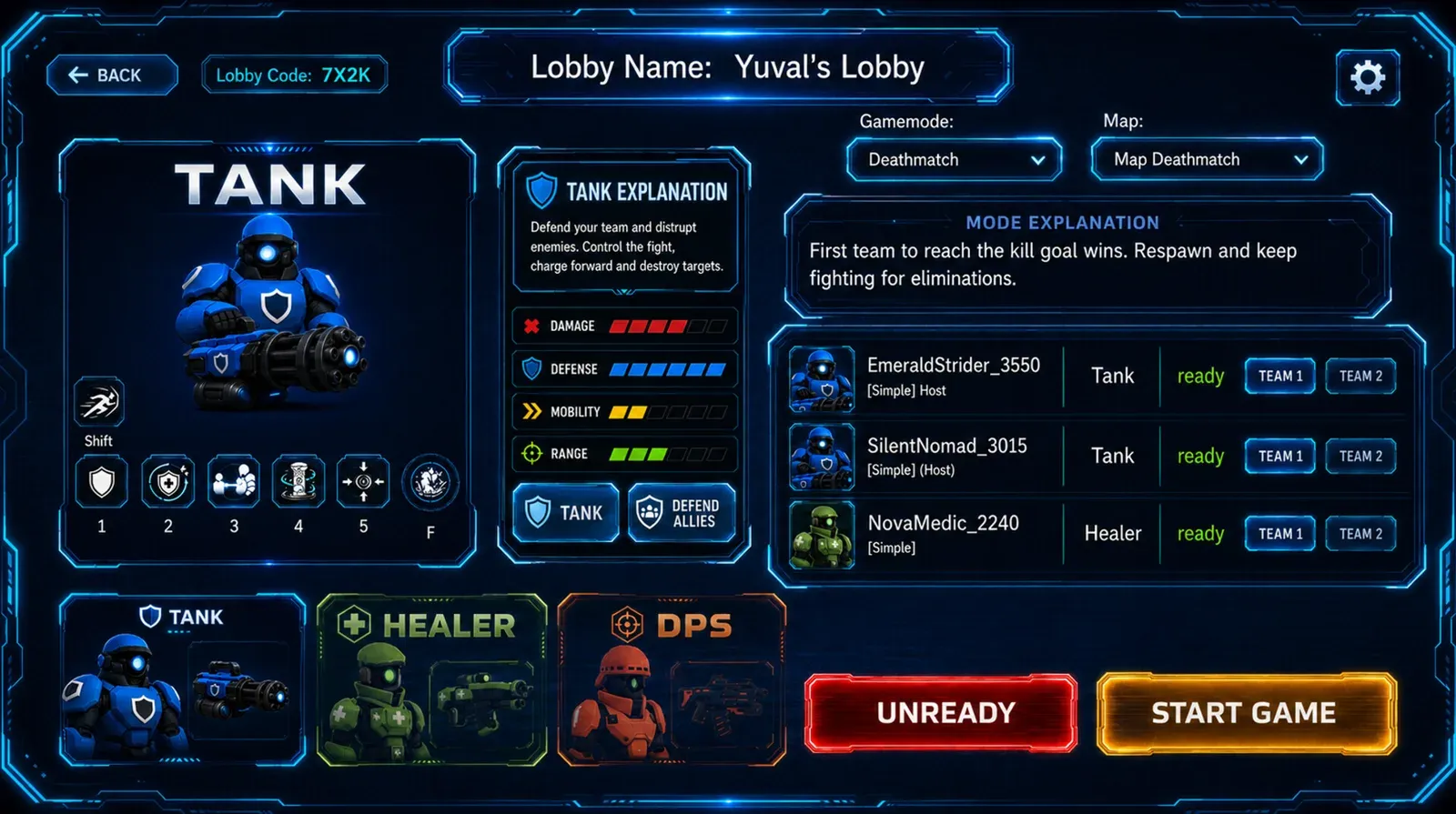
I do that loop on Tingbase: Unity 6, C#, a 3v3 hero shooter on Steam (app 4086630). Tank, DPS, or Healer. PvP arenas, deathmatch, and co-op waves. That project is already larger than a one-verb toy. The scoping rule did not change: one loop, three roles that share it, and a page I can point at. For a new project I would take Unity 6.3 LTS (Unity’s page: support through December 2027).
Pick the engine after you can name that verb: Unity vs Unreal Engine or best game engines for beginners. If that engine is Unity, how to make a game in Unity is the first build. “Build my game” is a request with no list. A named behavior is a request you can finish.
What you want to add
What do you want to add?
That verb is a second game. Finish the one you have, with a way to start, lose, and quit.
Write the sentence, then write what is out
Put the game in one sentence: who does the verb, where, and how a try ends. Summer Engine’s first-game picture is one mechanic, one setting, and either a few levels or one loop that repeats with variation. Sefism’s lesson is the same shape on one page, and the page also lists the features that are out. If the page needs a second sheet, the game is still two games.
Tingbase’s sentence, as the Steam page states it, is a 3v3 hero shooter with three roles. That is already a locked loop. A new first game should be smaller than that unless you already finished one.
Sort the rest with four labels. Must is what the game cannot start, end, or be understood without. For this project that is the verb, the fail state, and the few things those two need. Should is useful, and it is the first cut when the hours run short. Could is the idea you are excited about. Won’t is the decision you write so you do not argue it again in month four. Generalist Programmer calls that written “won’t” the bucket that earns its place, because the argument is already over.
Write the cut order while you are calm. The page says what drops first, then second. When the week is behind, you read the next line.
Reopen a cut only with evidence. A written reason, a playtest note, a timed piece that proved the list was wrong. A mood at 1 a.m. is not evidence. The later list is allowed to exist. It is not allowed to walk back into the build without a sentence you can read in the morning.
Time one piece before you time the game
Guessing the whole game from enthusiasm is how the list lies. Build one representative piece in plain shapes. Sefism calls that grey box a prototype you can throw away, and the trap is adding story or art before the verb works on its own. If the boxes are not fun, the painted version will not rescue them.
Then write down how long that piece took. Ship a Game’s estimate is that measurement, times the number of pieces, plus the work around them: menus, the save, testing, and whatever you promised for release. Linclo Games makes the same demand as a list. After a prototype that runs from launch to exit, with basic play, basic menus, one enemy, one ability, and one level, you write every asset the finished version still needs. Art, animation, sound, interface, music. Each line gets a time, and the time includes polish. The total is the scope you actually have. Trim until that total fits the hours you can give it.
A room of the same verb is content. Ten rooms are the room you timed, multiplied, plus the menu that lets someone pick one. A second verb is a second set of rules, a second fail state, and a second thing the screen has to explain.
The content multiplier
Ship a Game treats one content multiplier as part of the lock, not as leftover decoration. The multiplier is the thing you repeat after the verb works: more rooms of the same rules, more waves, more heroes that share the same abilities and the same fail. Tingbase’s multiplier, as the Steam page names it, is modes and roles around one shooter loop.
A multiplier is cheap only when the pipeline already exists. The first room teaches you the verb. The fifth room teaches you whether the art, the collision, and the spawn still take the time you wrote. If they take more, the multiplier is the lie. Cut rooms before you add a second verb to fill the week.
MVP, then one polished piece
Generalist Programmer and the GameMaker8 first-release notes keep two steps I first mashed together.
The MVP is the ugliest version that still contains the loop: colored boxes, a beep, one fail, a restart. Its only job is “is this fun at all?” I do that in Unity by pressing Play on one C# behavior, which is the trip on the Unity and Cursor page. If the boxes are not a game, more art will not save them.
One polished piece answers a different question. The grey box asks whether the verb is fun. The polished piece asks how long a finished chunk really takes, with its art, its sound, and its interface. Use that second number for the rest of the list. A guess made before you have finished even one chunk is still a wish.
Prove the build path first. A blank project that launches outside the editor. Then the loop. Then one differentiator. Then feedback that explains the state, not decoration.
Say what remains after a loss
A fail state is part of the scope, because it decides the data. Ship a Game asks what persists. A run that resets to a clean room is one job. A local high score is another. Story flags, unlocked levels, and a permanent upgrade are more jobs, because each one has to be saved, loaded, and tested against the fail state. Write the one you mean. “It saves” is three different games.
The same honesty applies to the machine. One computer, one player, keyboard or a controller, offline, is a test you can run tonight. “PC” is still several promises if you also mean a controller, a Steam Deck, and a second operating system. Promise the line you can verify. Accounts, matchmaking, and a cloud save are a later project.
Tingbase is already the online case: 3v3, PvP arenas, deathmatch, co-op waves. So a first game doesn’t have to be a single-player toy. Just remember that each of those modes multiplies the work on the same verb.
The store page is also scope
Shipping also means the work after the loop plays. A store listing, a build someone else can install, an age rating, a trailer, a page that names the genre without lying. That is not marketing you add on the last Friday. It is part of the hours.
Tingbase’s public list is the Steam page. App 4086630. If your first game will sit on Steam, the page is a Must the same way a quit button is a Must. A page that promises a second platform you have not built is a second game.
A tutorial is the other hidden line. Every new system means you owe the player an explanation. Ten clever systems are ten explanations. The first game can teach one verb on the first screen.
The calendar is a poor boss
The published ranges do not agree, so a number of weeks is not the test. Sefism says a first game should take two to six weeks, around one mechanic. Summer Engine says about a month, and points at Celeste Classic: two developers, four days, in PICO-8, a small version that later became Celeste on Steam in January 2018. A scoping guide updated in 2026 says most first solo games that actually ship take about three to nine months of full-time work, or nine to eighteen months beside a job, and that a plan past a year of full-time work is a reason to cut rather than a reason to extend.
Use that disagreement as the warning. The measurement is the timed piece set next to the hours you have. If the list does not fit, cut the list. A longer calendar with that list is how a first game stays unfinished.
Give each milestone one testable outcome, which is the GameMaker8 rule: the loop plays, the level is complete, the screen is final. “Make it better” is not a milestone. When a deadline nears, cut a feature rather than a test pass. A smaller finished game beats a larger one that never reaches players.
A new idea waits on the later list
Ideas arrive as single afternoons. Crafting. A day-night cycle. A friend who can join. The code for each one is often small. Generalist Programmer counts the rest of the cost: art, interface, edge cases, a save, balance, bugs, and the way the new piece touches every system you already have. A 2026 guide adds the tutorial you now owe the player. Ten of those afternoons are a different game.
Write the idea on the later list the hour you have it. Look at that list at the next point you already scheduled, and only against the sentence on the one-page note. If it serves the verb, it can enter when a Must item is done. If it opens a second verb, it stays on the list. The playtest is how you learn whether the verb you kept is the one a stranger actually meets.
When the shell exists, stop adding. Fix what breaks, and play the build. The first game is finished when a stranger can start it, lose, and try again, and you can explain the scope in the original sentence. The later list is the start of the next one.
Related: Game development, What is game feel, Mini Games Arena, projects.
Common questions
How long should it take to make your first game?
Anywhere from a few weeks to several months, depending on scope. Build one small piece first and time it, then check whether your feature list fits the hours you actually have.
What should I do with new feature ideas during development?
Write them on a 'later' list and keep building. Review that list when you planned to, not the moment the idea pops up.
Is a game design document the same as the game?
No. The design document is the promise; the game is the build that keeps it, with a way to start, a way to lose and a way to quit.
Can my first game be multiplayer?
It can, but expect a much bigger project. Accounts, matchmaking and online play add a lot of work; my game Tingbase is a 3v3 online hero shooter, which is far bigger than a simple first game.
What is the difference between an MVP and a vertical slice?
An MVP is the roughest playable version that tests if the core idea is fun. A vertical slice is one small part finished to release quality, which shows you how long real content takes to make.
What is a content multiplier in game development?
It's the thing you repeat once the core mechanic works, like more levels, waves or heroes. Each one costs real time, so count it as part of your scope.
Does a Steam store page count toward game scope?
Yes. A store page, age rating, trailer and an installable build are all real work, so plan time for them like any other feature.
Keep reading
Game development
Best AI tools for game development
A ranked, category-by-category list of AI tools I actually use or would pay for in a Unity 6 project: Cursor, Copilot, art, 3D, audio, animation.
October 20, 2026 · 8 min read
Game development
Best game engines for beginners
Unity, Godot, Unreal or GameMaker? Which engine to pick for your first game, from someone shipping in Unity 6.
October 20, 2026 · 7 min read
Game development
How to make a game in Unity
A Unity 6 beginner path from Hub install to a playable loop. Written from Unity 6 C# work on Tingbase, not from a copied 2022 tutorial.
October 20, 2026 · 7 min read
Game development
Indie game marketing on Steam
How Steam wishlists, Coming Soon pages, demos and Next Fest actually work, from a dev with a live Coming Soon page.
October 20, 2026 · 8 min read