
Game development
Based on the makers’ specs and my own testing where I say so.
What a playtest is for
A playtest checks whether someone who did not build the game gets the experience you designed. Your own pass can find a crash. It already knows the path.
Updated 6 min readYuval Eizik
- tingbase

On this page
A playtest is there to find out whether someone who did not build the game gets the experience you designed. Jesse Schell’s line, quoted in a Carnegie Mellon class note from February 2020, is getting people to come play your game to see if it engenders the experience for which it was designed.
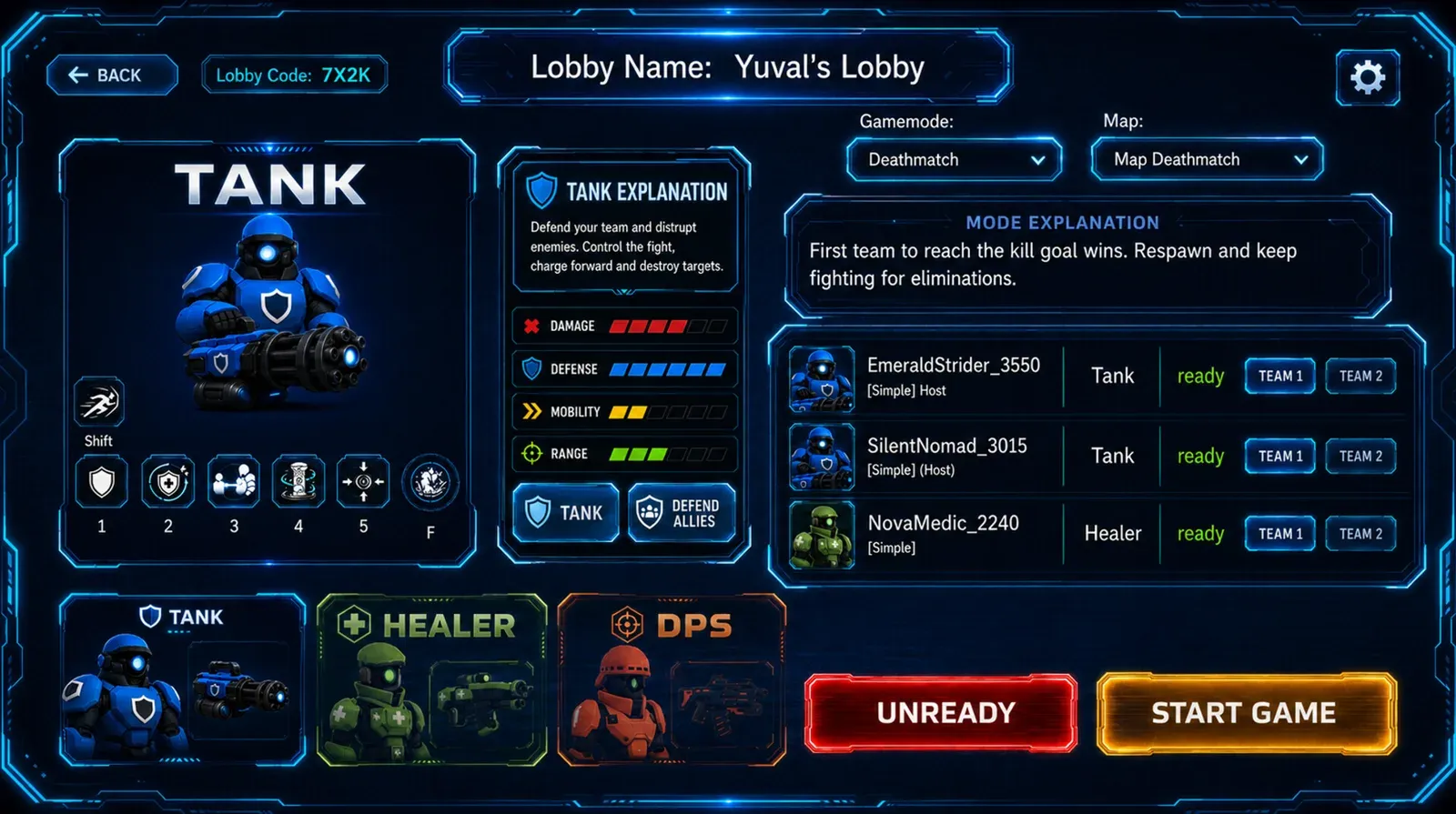
I make Tingbase in Unity 6 and C# (Steam app 4086630): pick Tank, DPS, or Healer, and play PvP arenas, deathmatch, or co-op waves. The Unity and Cursor loop is how I change one C# verb.
You already know that path. A pass you play yourself can find a crash, or a number that feels wrong in your hands. It cannot show you the first confusion, and an explanation deletes that confusion. How to write the moment down lives on the note page. What you are testing is the smallest loop: one action, a visible result, and a reason to try again, for someone who has not heard you describe it.
| Job | Question it answers | Wrong sample |
|---|---|---|
| Your own Play click | Does it crash? Does a number feel wrong to you? | Treating that as a stranger's first minute |
| Bug / QA pass | Did the implementation match the rule? | Calling a crash "balance" |
| Playtest | Did the rule produce the experience you wrote down? | Explaining the control before they try |
| Frozen-build survey | A record of what shipped | A decision you can no longer make |
Who is about to play
Who is about to play?
You already know the path. This pass can find a crash. The playtest starts when someone who did not build it plays without the explanation.
The word covers three different jobs
Steve Bromley, writing for Games User Research in a page updated on March 24, 2026, says teams use “playtest” for three different activities, and the mix-up is expensive because everyone agrees the word matters.
The first meaning is internal play. Any time a build is played counts, including quality assurance and the hour you spend in your own game. Bromley says this meaning is common on hobbyist teams and early in a career. Testing your own build isn’t a playtest. A playtest needs someone who’s never seen the game.
The second meaning is external exposure. Someone who is not on the team plays, and you keep what you learn. Watching them is one method. A survey after they play is another. Bromley uses this meaning: a playtest exposes players to gameplay in order to gather data. The team is the wrong sample for that question.
The third meaning is a multi-seat test. A lot of players are in the room at once, and the session collects whether they like the game. That is one method. A single stranger, on one question, is still a playtest under the second definition.
Before the session, Bromley wants three answers said out loud. Who are the players? What are you trying to learn? What kind of data are you expecting? On a small project the third answer is the note: where they were, what they tried, what they expected, and what the game did. If you cannot say the question, you will come back with “felt good,” and that sentence cannot be built.
A crash and a wrong feeling are different findings
Wikipedia’s video-game section describes a playtest as exposing a game in development to its intended audience, to find design flaws and gather feedback. It separates that job from quality assurance, where a tester looks for a specific software bug. Bungie’s June 24, 2020 note on its own test practice draws the same line from the other side. Traditional testing asks whether the implementation matches the design, and whether a glitch needs to be logged. Playtesting asks whether the event had the effect you wanted, whether the mood arrived, and whether it is fun to play.
Both findings can show up in the same hour. A player who falls through the floor has found a bug: the game broke its own rule. A player who stands still because they thought the heal would land, and it did land, and the teammate still died, has found a design problem: the rule worked, and the experience was still wrong. The note page keeps those on separate lines so you do not polish a crash and call it balance. The session’s job is the second finding. The crash gets written down so it can be fixed. It is not the reason you invited someone who had never seen the build.
PlaytestCloud’s article on the point of a playtest makes the same cut by timing. Bug hunting is a pass over a feature that is supposed to be finished. A playtest is repeated while the design is still moving, so the next session can show what a change did to someone’s enjoyment. PlaytestCloud wants people from the rest of the project in the room, because a ticket never shows the hesitation.
Say the experience before they sit down
The question has to be specific enough that a stranger can fail it. “Do they like it?” has a compliment as its answer. “In this fight, do they retreat when they are losing?” can be watched. In Games User Research’s guide to a community playtest, Bromley writes that kind of sentence: from this battle, players learn that retreat is worth it. You write the one you actually designed. Then you watch whether they do it.
On Tingbase the verb on Steam is: pick a role, enter a match, play until it ends. A question that fits that verb is watchable. “Did they understand Tank / DPS / Healer?” is a question. “Is it fun?” is not.
If they say the game is cool, you still have the question. Did they retreat? The note keeps the attempt and the expectation. Those two lines are the difference between a compliment and a finding.
You will be tempted to talk. The build is missing a tutorial, the control is temporary, the numbers are placeholders. Say that after they have tried. If you say it before, they are playing the version you described, and the session answers a different question: can they follow you? The playtest answers whether the game, alone, produces the experience.
Run it while the rule can still change
PlaytestCloud says teams often leave this until the end, when little time remains to change the experience the player will actually have. A session after the work is frozen can still be interesting. It cannot do the job. The job is a decision you are still allowed to make: change this rule, or leave it, because of what this person did. How to cut a feature is that decision when the answer is out.
PlaytestCloud’s practical claim is that adjusting often, through development, costs less than a rush at the end. Put a stranger on the verb while the verb is still a small change. Retest the same question after you change it. One session tells you the experience missed. The next session tells you whether your change was the reason it landed.
In Unity, the change is one script. Read the diff. Press Play. Then, if you have a stranger, shut up and watch.
What you leave with
You leave with a decision, or with a reason you are leaving the rule alone. Bromley’s purpose for putting real players in front of the game is a confident decision for the rest of the team. The note page is where that decision gets its evidence: the attempt, the expectation, and what the game did. “Healing feels weak” cannot support a change. The moment can.
One person’s taste is a weak reason to rebuild a rule. A wall that several people hit, on the question you stated before they sat down, is the finding the session was for. Fix that, or decide in writing to keep it. Then the playtest is finished. The next one asks the next question.
Related: Game development, How to make a game in Unity, Mini Games Arena, projects.
Common questions
Does playing my own game count as playtesting?
Not really. You can catch crashes and balance issues, but a real playtest is someone who didn't build the game playing it without your explanations.
What should I ask when a playtester says it was fun?
Ask what they were doing right before they said it. Fun is the result; the action that caused it is what you need to know.
Is playtesting the same as bug testing?
No. Bug testing checks whether the game works correctly, while playtesting checks whether players have the experience you want. Log crashes separately.
When is it too late to playtest?
When you can't change the game anymore. Playtest early, while feedback can still shape your decisions.
What is Tingbase?
Tingbase is the 3v3 hero shooter I'm building in Unity 6 with C#. It's on Steam, and playtests help me decide which features to keep.
Keep reading
Game development
Best AI tools for game development
A ranked, category-by-category list of AI tools I actually use or would pay for in a Unity 6 project: Cursor, Copilot, art, 3D, audio, animation.
October 20, 2026 · 8 min read
Game development
Best game engines for beginners
Unity, Godot, Unreal or GameMaker? Which engine to pick for your first game, from someone shipping in Unity 6.
October 20, 2026 · 7 min read
Game development
How to make a game in Unity
A Unity 6 beginner path from Hub install to a playable loop. Written from Unity 6 C# work on Tingbase, not from a copied 2022 tutorial.
October 20, 2026 · 7 min read
Game development
Indie game marketing on Steam
How Steam wishlists, Coming Soon pages, demos and Next Fest actually work, from a dev with a live Coming Soon page.
October 20, 2026 · 8 min read