
Hardware
Based on the makers’ specs and my own testing where I say so.
What an IEM for gaming has to do
Are in-ear monitors good for gaming? Here's when they beat a headset. The plug has to carry the mic if you talk.
Updated 11 min readYuval Eizik
- pc
- headset
This article has affiliate links. If you buy through them, I may earn a small commission at no cost to you. Prices move fast, so check the store for today's price before you buy.
Read the disclosure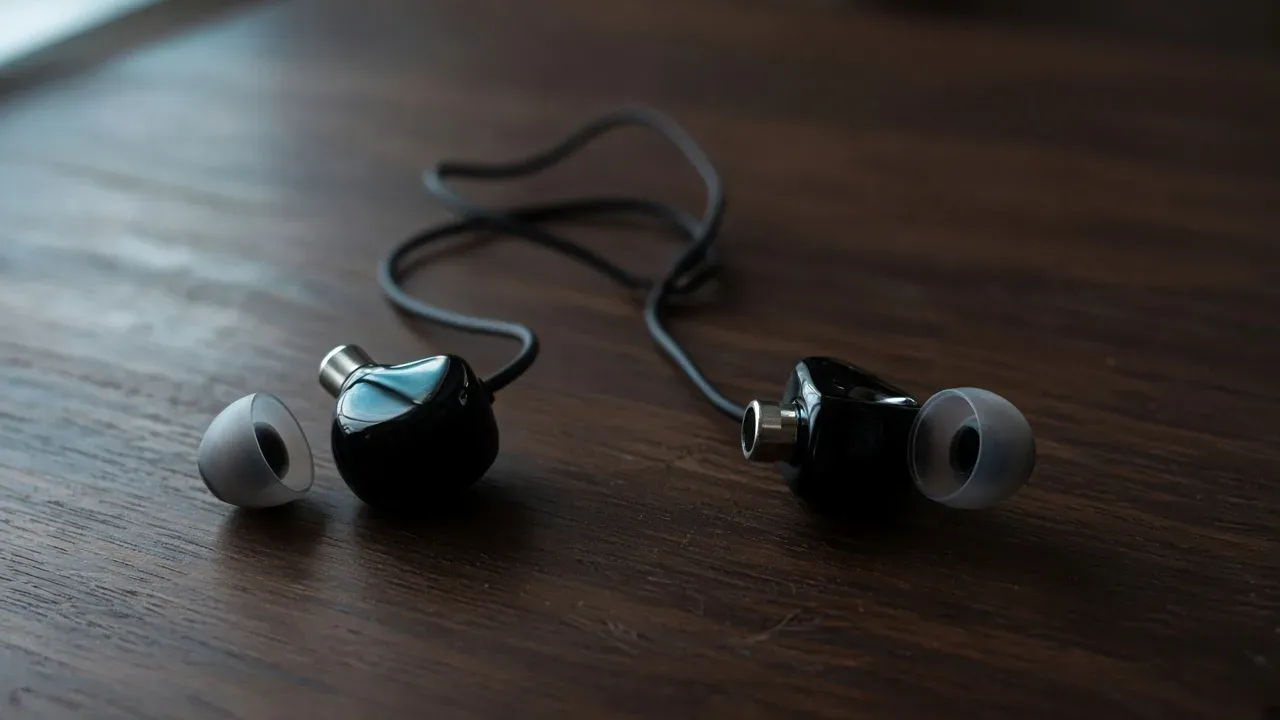
On this page
As an Amazon Associate I earn from qualifying purchases. I earn a small commission from Amazon links, at no cost to you. See disclosure.
Tired of a headset clamping your head? An IEM for gaming is a canal seal and a cable, for the session where a headset is the problem. The letters mean in-ear monitor. A short nozzle and a tip close the ear canal, and the cable is how that seal meets the machine. For full picks, see the best gaming headsets. This guide covers the seal and the cable. Gaming earbuds already covers the radio, the tip sizes, and a mic that lives in the bud. More headset guides.
IEMs don’t improve footstep positioning; the game does that. I play Overwatch as Zarya, peak Master 1, at 1200 DPI. I sit at an RTX 5080 and an AMD Ryzen 9 9950X3D2. The known-gear list names a Logitech PRO 2 LIGHTSPEED mouse, not a pair of shells.
IEMs worth a look
- Sony INZONE E9 (IER-G900 / IER-G900B): Official US $149.99. Closed dynamic driver, L-shaped stereo mini plug, detachable Y-type cable about 1.8 m, USB-C audio box, noise-isolation and hybrid tips. The box enables virtual 7.1 and 360 Spatial Sound in INZONE Hub on Windows. Sony does not print a microphone. Sony US. IER-G900 specs. Amazon search for INZONE E9
- Razer Moray (RZ12-0445): June 27, 2023 newsroom $129.99 USD MSRP. Support sheet, 3 March 2026: hybrid dynamic + balanced armature, 32 Ω, 20 Hz–24 kHz, MMCX cable about 1.6 m, 4-pole mini plug, silicone and foam tips. FAQ: no mic function. Shop page: up to -36 dB isolation; ears 17 mm across and 24 mm tall and bigger. Razer Moray. Support specs. Amazon search for Razer Moray
- Logitech G333: Dual dynamic 5.8 mm + 9.2 mm, 4 mm ECM inline mic, 3.5 mm plus USB-C adapter, three tip sizes, 19 g. Names PC, mobile, Xbox, PlayStation, Nintendo. Check the live price on Logitech’s site. Logitech G. Amazon search for G333
The short version: seal the tip, match the plug, record the mic if you talk. The word gaming is not those three checks.
Where the microphone sits
Where the microphone sits
The mic is on the cable, closer to your collar than to your mouth. It can work in a quiet room. It is still not a boom.
The three stops are positions. A mic in the shell shares the air with the keyboard and the fan. A mic on the cable sits nearer your collar than your mouth, and it moves when the cable moves. A short boom sits nearer the mouth. EPZ’s June 22, 2026 guide says that closer placement can pick up a voice more consistently than an inline mic that slides with the cable. In a noisy room, if you lead the call, start with a headset boom.
I type on UHJK at a tower that already clicks. That is a noisy-room test. A canal mic is not a boom just because the bag is smaller.
Record about ten seconds while the room is quiet, then again while you type. Listen on another device, and ask one person in the chat you already use whether the words stay clear. A tone or a light has to show that mute took. Closed tips make your own voice sound quiet. Sidetone plays that voice back in. It does not improve the microphone.
| Official SKU | What the maker printed | Mic on the sheet? | Plug I could verify | Official price I could verify |
|---|---|---|---|---|
| Sony INZONE E9 (IER-G900) | Closed dynamic IEM, USB-C audio box, tips in the box | No mic printed | L-shaped stereo mini; USB-C box is extra | $149.99 on Sony US |
| Razer Moray (RZ12-0445) | Hybrid DD + BA, MMCX, silicone and foam tips | Razer FAQ: no mic function | L-shaped 4-pole mini; still no mic | $129.99 launch MSRP; confirm shop |
| Logitech G333 | Dual dynamic 5.8 + 9.2 mm, three tip sizes | 4 mm ECM inline mic | 3.5 mm + USB-C adapter | Confirm the US listing |
What the letters name
EPZ, in a guide published June 22, 2026, describes an IEM as a nozzle with a silicone or foam tip that seals inside the canal. That is a tighter fit than an earbud that rests near the entrance and can leave a gap. Razer’s own Moray FAQ uses the same split: the Moray is an IEM because the low-profile shape sits in the ear canals, unlike earbuds that rest on the outer ears. If you wanted the radio and the case, you are on the earbuds page.
The same EPZ guide says a gaming IEM is a product category, not a formal standard. There is no required driver count, no required frequency response, and no required cable type. A regular music IEM can play the game. A poorly tuned shell does not become a match tool because a microphone was clipped onto the cable.
The listing has to show the nozzle, more than one tip size, and the plug. A render of a dark shell is not those three things. EPZ’s myth section says more drivers do not guarantee tuning or imaging. Sony’s E9 is one dynamic driver. Razer’s Moray is a hybrid. Logitech’s G333 is two dynamic drivers. Leave the count alone until the seal and the plug are settled.
SoundGuys, in an introduction by Jhaycee Calvez published October 14, 2026, says people reach for IEMs when they think of a shooter, then points at story games, action games, and quiet ones. A built-in mic is not required when you are not the person talking. The rest of their page is a list of sets they say they have tried. I haven’t tried those sets, so I won’t pick a winner.
The seal you can check
A useful seal drops the room the moment the tip is in, before any noise-cancelling circuit is on. Try every tip in the box, left and right. EPZ says a leak on one side can shift bass and the left-to-right balance. That is a fit problem. Fix the tip before you blame the tuning. Sony’s E9 box includes noise-isolation and hybrid tips. Razer’s Moray box includes silicone and foam in three sizes each. Logitech’s G333 box includes three silicone sizes. The extra tips are the product. A single “one size” tip is an incomplete listing.
Foam seals more tightly and compresses as it ages. Silicone is easier to wipe. Neither is a rank. The one that seals your ear, and that you can wear after an hour, is the one. EPZ treats that hour as a requirement: a shell that hurts has already failed the session it was bought for. Pain in the canal is a return. Razer prints a starting ear size for the Moray. That is their filter, not a promise that your canal matches.
Active noise cancelling, if the pair has it, reduces a steady hum after the seal exists. It can’t create a seal the tip missed. Most of the official gaming IEM SKUs above are passive. Sony’s E9 page talks about a sealed body and isolating tips, not an ANC slider. Tips and insertion depth still color the sound. If one depth seals and stays comfortable, leave it. If every depth leaks or hurts, that shell is the wrong shape. Headset fit is the cup version of the same return rule.
The plug, if you talk
Hearing the game does not prove the microphone is connected. TINHIFI, in a support note dated September 27, 2026, says a passive pair needs a mic in the cable, an accessory mic, or a separate microphone.
A plug with two black rings, TRS, is left and right. Sony’s E9 stereo mini plug is that listening plug. A plug with three rings, TRRS, can carry stereo and the microphone. Controllers and many laptops use that single plug. EPZ says a 3.5 mm TRRS cable is the useful one for those machines, and that USB-C can add a converter, a small DAC, EQ, or mic processing. The plug you need is the socket you will use.
Count the rings, then read the words. Both plugs are 3.5 mm, so that sentence is unfinished. Razer’s Moray is the warning: the sheet says a 4-pole mini plug, and the FAQ says no mic function. Four poles don’t add a microphone by themselves.
On a desktop with separate headphone and microphone sockets, TINHIFI says you may need a headset breakout. A splitter that shares one song between two listeners will not give the PC a microphone. A USB adapter has to say it has a mic input. Sony’s E9 USB-C box is surround and EQ on a PC, not automatically a voice path. If you already like a music IEM and you talk, the missing piece may be a cable with a mic. TINHIFI’s later note on the same day says you can keep the shells and split listening from speaking.
On a PlayStation or an Xbox, the box has to name that console, or you use the 3.5 mm plug into the controller. Sony’s E9 page allows the stereo mini plug into a controller. Logitech’s G333 page names Xbox and PlayStation. As of 2026, neither console takes a normal Bluetooth earphone as the game connection. A PC dongle is on the earbuds page.
A stage stack stays on the stage
EPZ warns that professional use is often offered as proof the shells sound better. The reason they describe is the stage. A fitted IEM reduces outside noise before any electronic cancelling. An outer headset can add another layer, or play masking noise, while the IEM carries the monitored mix. EPZ cites Riot’s VCT Pacific double-isolation setup as one published example: team audio in the IEMs, white noise in the outer cups. That is an event rule, not a home shopping list.
A full-size gaming headset cannot sit underneath another headset. A low shell in the ear can. Sony’s E9 page says the low-profile fit can sit under an over-ear tournament headset. EPZ says that double layer is not something most home players need. If you want that outer layer at home, the headset is the product that solves it. More on FPS headset mix.
How the picture sits
Many IEMs sound more intimate than cups that surround the ear. EPZ splits two words people mash together. Soundstage is how large the space feels. Imaging is whether a cue sits in one place inside that space. Competitive play usually wants the second. A huge stage with vague locations is the miss. A headset can image well. The format alone does not decide it.
Excess treble can make a long session harsher and distance harder to judge. Footsteps change with the game, the surface, and the distance. A tune that turns every cue into the same sharp tick throws that difference away. Game EQ is the slider page after the seal is already honest. Lower the game’s music until the step is what you hear. Sony’s E9 USB-C box adds virtual 7.1 and 360 Spatial Sound in INZONE Hub. Those modes need the USB-C adaptor and Windows. Hear the stereo mini plug first. A shift that follows a tip swap is the fit.
Impedance on these three official sheets is low: 16 Ω on Sony’s E9 support spec, 24 Ω ±20% on Logitech’s G333, 32 Ω on Razer’s Moray. All easy to drive from any jack. Headset impedance is the longer version of that number.
When the headset is in the way
A closed-back headset surrounds the ear and usually brings a boom. Gaming earbuds are often a 2.4 GHz dongle, a case, and a mic in the bud. An IEM is a tip in the canal and a cable. EPZ’s comparison is the useful one: the IEM is lighter and cooler, and it can sit under another headset. The headset still wins when you want a boom already on the cup, or a wireless dongle you already trust.
If the room is loud and I am the person talking, I would still open a boom first. The Cloud III is a good wired one. Glasses, heat, and a cup that will not fit in a bag are the ordinary reasons to leave that headset on the desk. An IEM is the wrong buy when you cannot stand a tip in the ear, when you want a wide cinematic picture, or when you need a wireless match radio. Wireless is the earbuds page or the headset page.
Wear the pair through a real match. If you take one shell out to hear the room, you wanted a shape that rests outside the canal. Route the cable behind the monitor so it stays off the mouse. Sony lists a thin 1.8 m cable and a flexible ear hook. Razer lists over-ear memory-loop tubing. Those are routing details. They do not move the microphone.
I aim Overwatch on Zarya. Stereo first, music down, one spatial layer at most. An IEM that isolates the room can also isolate a person who needs to talk to you. If you have to hear the house, a tip in the canal is the wrong product.
What the listing has to show
Ignore the word gaming until the page shows these:
- A nozzle and tips in more than one size, foam or silicone. The seal is the result.
- The plug: TRS, TRRS, or USB-C, in words or in a photo of the rings, and the machines by name.
- Where the mic is, if you talk: in the shell, on the cable, or a short boom. Silence about a mic means a listening pair. A 4-pole plug is not enough, as Razer’s Moray FAQ shows.
- A mic input on any USB adapter in the box, if you talk.
- A mute you can confirm, if the mic exists.
- The return window. The first hour is the fit test.
Prices move. Recheck the current listing before you pay. No model stays the IEM for gaming. A music pair you already trust, with a seal and the right plug, is a complete way to hear the game.
Decision rule: if the tip seals, the plug matches the socket you will use, and a recording of your voice is clear when you talk, you are done. If any of those three fails, change that one thing. Do not buy a new driver count. More headset guides.
Common questions
What are gaming IEMs?
Gaming IEMs are in-ear monitors that sit in your ear canal with a sealing tip and connect with a cable your device supports. 'Gaming' is a marketing label, so a good music IEM works just as well.
Are IEMs better than a gaming headset?
They're better if you wear glasses, get hot or need something portable. A headset is still better for voice chat in a noisy room because of its boom mic.
Do gaming IEMs have a microphone?
Not always. A TRS plug carries audio only, while a TRRS plug can include a mic; if your pair has none, add a cable with a mic or use a separate microphone.
Why do pro players use IEMs?
Pros wear IEMs under big isolation headsets at events, so team audio stays in their ears while the outer headset blocks crowd noise. At home, you don't need that double layer.
What is the best IEM for gaming?
There's no single best. Choose a pair that seals comfortably, has a plug your device supports and includes a mic if you talk in voice chat.
What is the difference between gaming IEMs and gaming earbuds?
IEMs seal inside your ear canal and usually use a cable, while gaming earbuds are typically wireless with a charging case, dongle and built-in mic.
Do more drivers make a better gaming IEM?
No. Driver count doesn't guarantee better sound or imaging; Sony's INZONE E9 uses a single dynamic driver. Fit and tuning matter more.
Do IEMs work on PS5 and Xbox?
Yes, with a 3.5 mm plug into the controller. Consoles don't support regular Bluetooth earphones for game audio, so wired is the simple option.
Can I use music IEMs for gaming?
Yes. If they seal well and have the right plug, music IEMs work great for games. If you need to talk, add a cable with a mic or a separate microphone.
Keep reading
Hardware
What a gaming audio interface is
A gaming audio interface is the box that converts an XLR microphone into a computer input and plays the computer back through headphones.
October 20, 2026 · 10 min read
Hardware
What a headset for FPS games has to do
An FPS headset is the connection the machine accepts and cups you can wear. The game already places the step in stereo.
October 20, 2026 · 10 min read
Hardware
What a noise cancelling gaming headset has to do
Is a noise cancelling gaming headset worth it? When ANC helps, when it adds hiss, and three good picks.
October 20, 2026 · 9 min read
Hardware
What a USB gaming microphone is
A USB gaming microphone is a desk capsule with the converter in the body. You still hear the game in a headset. The room decides dynamic or condenser.
October 20, 2026 · 10 min read