Hardware
How to choose gaming earbuds
Gaming earbuds are the right buy when a headset gets in the way. Match the radio to the machine, seal the tip, and switch to a boom if you talk in a noisy room.
Updated 5 min readYuval Eizik
- pc
- headset
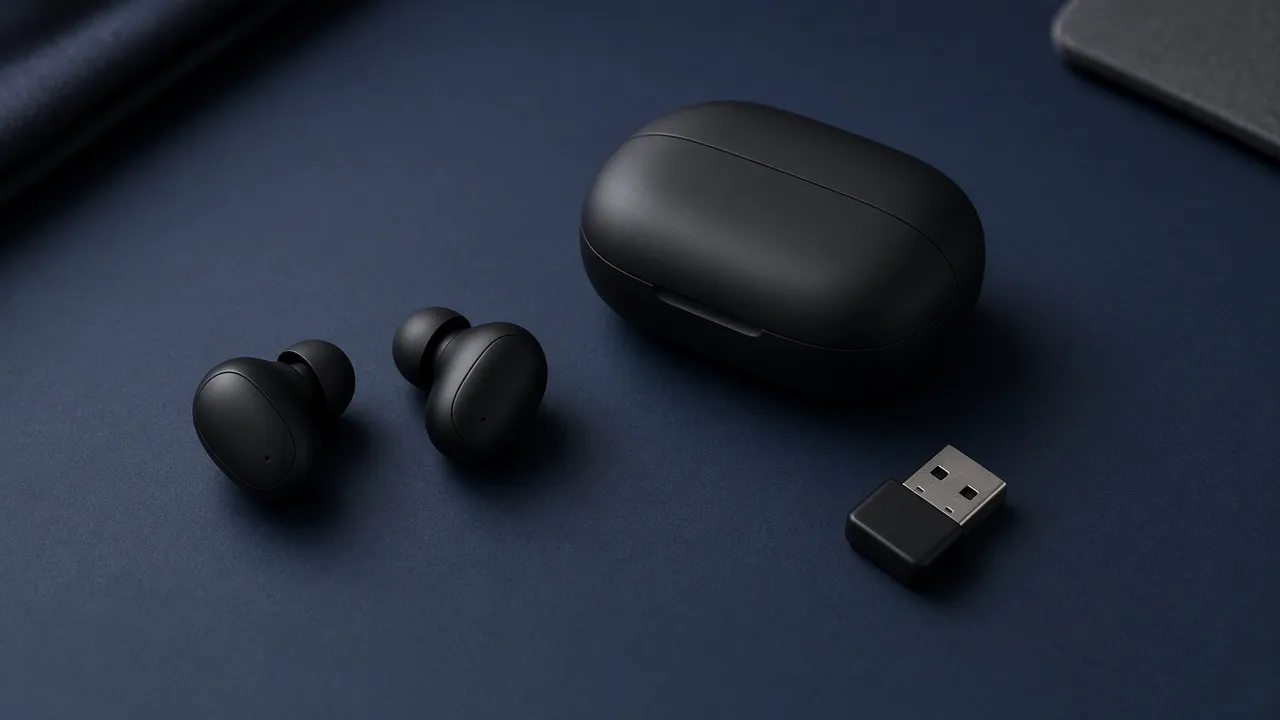
Gaming earbuds are headphones that sit in the ear instead of over it. The best pair is the one that seals, uses a radio your machine accepts, and does not pretend to be a boom microphone. They are the right buy when a headset is the problem: glasses under the pad, heat on the ear, or a cup that will not fit in a bag.
They are the wrong buy when the room is loud and you are the person talking. A wireless headset puts a microphone by your mouth. An earbud puts it by your ear, in the same air as the keyboard and the fan. That geometry does not change because the box says gaming.
When earbuds are the wrong product
If you lead the call, stream, or play where other people are talking, start with a headset. Noise reduction on an earbud mic can help. It cannot move the mic closer. Use the return window if you are unsure, and do it with the room as it actually is.
Record about ten seconds while the room is quiet. Record again while you type, with the fan as it normally runs. Listen on another device, not through your own ears. Then join the chat app you already use and ask one person if the words stay clear. If they do not, the headset was the product.
A wire with a short mic on the cable is still an earbud, and on a controller it avoids the radio entirely. True wireless is the pair with nothing between the buds. Buy that when the cable is what you are trying to lose, not because a wire is obsolete.
Pick earbuds from the fit and the radio
Earbuds are a fit choice. This filter says when to buy them, which radio to read, and when a headset is the better product.
- Buy
- Earbuds
- Connection
- 2.4 GHz USB dongle
- Fit
- The tip that actually seals
Play on the dongle. Bluetooth is the slower link, and on a PC it is also the link that can thin the game audio when the mic turns on.
The result is a filter, not a model. The radio rules match a headset, with two earbud-only catches.
On a PC, play on a 2.4 GHz USB dongle when the game cares about timing, and whenever the mic is on. Bluetooth is the phone link, and it is the slower one. On many Bluetooth pairs, opening the microphone switches Windows to the call profile. The game gets thinner and often mono until you hang up the mic. A dongle keeps game audio and the mic on one link that was built for both. If a listing promises stereo and a Bluetooth mic at the same time, confirm it in that return-window recording. Do not take the box’s word.
On a PlayStation or an Xbox, the box has to name that console, or you use a 3.5 mm plug into the controller. As of 2026, neither console takes a normal Bluetooth pair as the game connection. A dongle that works on a PC is not automatically theirs. Read the current listing. A firmware note is how that sentence would go stale.
On a phone, Bluetooth is the connection that exists. A game mode or a low-latency mode is worth trying in a match. It will not turn the phone into a dongle. A story can live with the delay. A footstep cue is where you will notice it.
The tip is the noise cancelling you can check
A good seal drops the room the moment the bud is in, before any mode is switched on. Try every tip in the box. If you still hear the room through the game, the tip is too small, too large, or the wrong shape. Foam seals more tightly and compresses as it ages. Silicone is easier to wipe. Neither is a rank. The one that seals your ear is the one.
ANC, active noise cancelling, reduces a steady hum after that seal exists: a fan, an air conditioner, a distant road. It does not invent a seal the tip missed. A strong ANC can also add a pressure feeling during a long session. If that shows up, turn it off. The tip is still doing the useful work.
ENC, sometimes called mic noise reduction, is the other direction. It cleans what other people hear of your voice. A listing that only says noise cancelling has not told you which way. Read for ANC, ENC, or both. A pair can have either, or neither.
Transparency, or ambient mode, plays the room back in on purpose. Use it when someone is home, or when you need to hear a door. It is the opposite of the seal. Open-ear buds that rest outside the canal are that idea as the whole product. Footsteps then compete with the room. Buy that shape when hearing the room is the point, not when you are trying to find a step in a quiet mix.
The mic is in the bud, not on a boom
A stem puts the mic a little closer to your mouth than a mic buried in the shell. It is still not a boom. Judge it with the recording test above, in the room you play in.
Confirm the mic works on the connection you will actually use. Some pairs take the mic on Bluetooth and not on the dongle, or the other way around. A mic that only works on the slower radio is a bad deal if the dongle was why you bought the pair.
You also need a mute you can trust without pulling a bud out. A tap is fine if you can tell, from a tone or a light, that it took. Guessing is how a room hears a conversation you thought was private.
Closed tips make your own voice sound quiet, so you talk louder than the room wants. Sidetone plays that voice back into the buds. Turn it up until a normal voice is enough. It does not improve the microphone.
What the listing has to say
Ignore the word gaming until the page states these:
- The radio for the match. A 2.4 GHz dongle, Bluetooth, or a wire, and the machines by name.
- That the microphone works on that same radio.
- Which tips are in the box.
- ANC, ENC, or both, in those words. Transparency, if hearing the room matters.
- Battery hours for the buds and for the case, as the maker’s claim. A case that cannot finish a session is part of the product. Recheck the number on the current listing.
- The return window. Pain in the canal shows up in the first hour. Do not keep a pair that hurts because a review said the seal gets better later.
A codec name, aptX or LDAC or anything else, only matters when both the buds and the phone list it. The phone will not use a codec it does not have. A dongle sidesteps that negotiation. RGB on the case does not change the radio, and a surround logo does not place a footstep. The game already does that in stereo.
If the buds you already own seal, sound fine in the game you play, and you do not talk over a noisy room, you do not need a gaming pair. Spend the money when the fit or the radio is the thing that is wrong.
Common questions
Are gaming earbuds better than a headset?
They are better when cups hurt your glasses, get hot, or do not fit in a bag. They are worse when you talk in a noisy room, because the microphone sits in the ear instead of on a boom by your mouth. Buy the product that matches that problem.
Do gaming earbuds need a dongle?
On a PC, for a match or for voice chat, yes. A 2.4 GHz USB dongle is the low-delay link, and it keeps the mic from switching game audio to the thinner Bluetooth call profile. A phone uses Bluetooth. A story game can live with Bluetooth.
Do gaming earbuds work on PlayStation or Xbox?
Only when the box names that console, or when you plug a wire into the controller. Bluetooth is not the game connection on either console. A picture of a console on the listing is not that sentence.
What does noise cancelling mean on earbuds?
It can mean two different things. ANC reduces what you hear, such as a fan. ENC, or mic noise reduction, cleans what other people hear of your voice. A seal from the right ear tip does more for isolation than a weak ANC mode. The listing has to say which one it is.
Can I use gaming earbuds for voice chat?
Yes, in a quiet room, after you have listened to a recording made while you type. In a loud room, a headset boom is the better microphone. Confirm the mic works on the same connection you play on. Some mics work on Bluetooth and not on the dongle, or the other way around.
How should gaming earbuds fit?
The tip should seal. Outside noise should drop as soon as they are in, before any noise-cancelling mode is on. If every tip in the box leaks or hurts, that pair is the wrong shape. Pain is a return, not a break-in period.
Keep reading
Hardware
When a 4K gaming monitor is worth it
A 4K gaming monitor is worth it when the PC already holds its refresh rate and the desk fits about 32 inches. Competitive games usually belong at 1440p.
October 19, 2026 · 5 min read
Hardware
Where a budget gaming PC should spend its money
A budget gaming PC should spend most of its money on a named graphics card for the resolution you play. A glass case and a huge processor do not add frames.
October 19, 2026 · 4 min read
Hardware
What the best gaming keyboard actually is
The best gaming keyboard is the layout your desk can hold and the switch your fingers accept. A 2026 chart names whatever is in stock. Extra money buys one feature you can point to.
October 19, 2026 · 4 min read